
From "Lo" to "Accept All": What 57 Years of the Internet Taught Us About Trust

At 10:30 p.m. on October 29, 1969, a student programmer named Charley Kline sat at a computer in Leonard Kleinrock's lab at UCLA. He started typing "LOGIN" to a machine at the Stanford Research Institute, about 350 miles away.
He got as far as "L" and "O." Then the system crashed.
So the first message sent over the network that became the internet was "lo." As Kleinrock tells it: "as in 'lo and behold!'" About an hour later, the full login went through. That's why October 29 is now marked, informally, as International Internet Day.
Fifty-seven years on, about 6 billion people, 74% of the world, use the internet, according to the ITU. In between "lo" and today, the internet had to learn one hard lesson over and over again: trust.
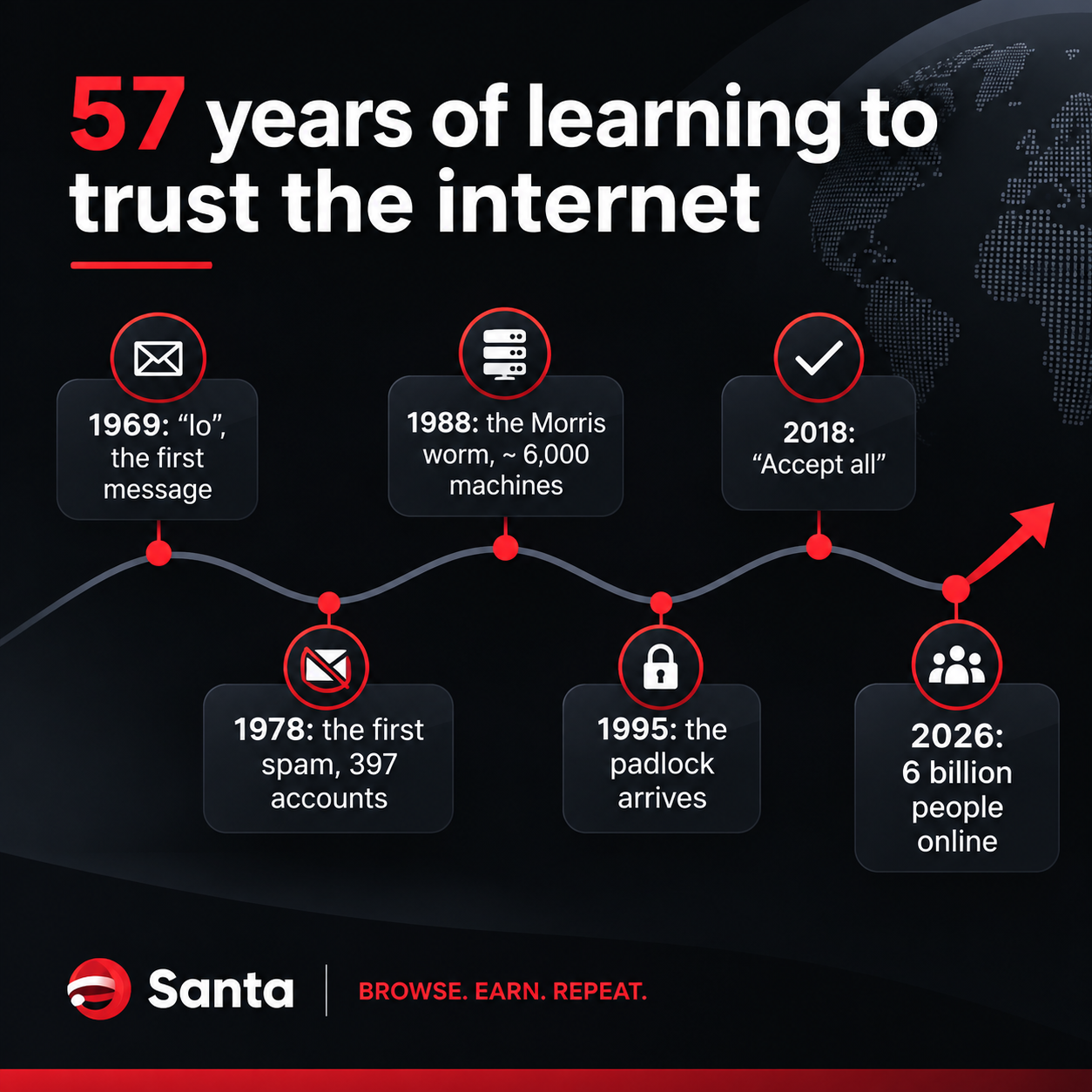
1969: Built for People Who Trusted Each Other
The early network linked a handful of universities and research labs. Everyone on it knew roughly who everyone else was. Nobody designed it for strangers, let alone criminals.
The people who built it have been open about this. Vint Cerf, one of the fathers of the internet, told The Washington Post in 2015: "We didn't focus on how you could wreck this system intentionally." His colleague David Clark put it even more plainly: "We knew that there were untrustworthy people out there, and we thought we could exclude them."
That's not a criticism. As Cerf added, "getting this thing to work at all was nontrivial." But it set the pattern for the next five decades. The internet was built on trust first, and security was added after.
1978: The First Unwanted Message
On May 3, 1978, a marketer at Digital Equipment Corporation named Gary Thuerk sent a product announcement to 397 accounts on the network. It's widely recognized as the first spam email.
The reaction was instant. An official at the Defense Communications Agency replied in all capitals: "THIS WAS A FLAGRANT VIOLATION OF THE USE OF ARPANET."
The lesson: once a network is open, someone will use it in ways the rest of the community never agreed to.
1988: The Day the Network Got Sick
On November 2, 1988, a graduate student released a self-copying program that spread far faster than he intended. The Morris worm hit an estimated 6,000 machines, roughly a tenth of the 60,000 or so computers connected at the time. Its author became the first person convicted under the US Computer Fraud and Abuse Act.
The lesson: on a connected network, one person's mistake or bad intent becomes everyone's problem. Security stopped being optional.
1995: The Padlock
As people started shopping and banking online, browsers needed a way to keep information private as it traveled. Encrypted connections arrived in the mid-1990s, and a small padlock in the address bar became the web's best-known safety symbol.
It worked. Today, over 95% of web requests use HTTPS, the encrypted version of the web.
But a symbol can teach the wrong lesson. In 2023, Chrome's security team pointed to a 2021 study in which only 11% of participants correctly understood what the padlock meant. Many thought it meant a site was safe or trustworthy. It only ever meant the connection was encrypted. And as the team pointed out, "nearly all phishing sites use HTTPS, and therefore also display the lock icon." Chrome replaced the padlock with a neutral settings icon later that year.
The lesson: a trust symbol is only as good as people's understanding of it.
2018: "Accept All"
When Europe's GDPR took effect in May 2018, far more websites started asking for permission before using cookies. On paper, that's exactly what the internet needed: ask first.
In practice, many consent screens were designed to get a yes. A 2020 study of popular consent tools in the UK found that only 11.8% met the minimum requirements of European law. The same research found that removing the "reject" button from the first screen raised consent rates by 22 to 23 percentage points.
The lesson: a question isn't really a question if one answer is a big bright button and the other is buried two screens deep.
2026: Trust at Planet Scale
Today, the stakes are bigger than ever. In 2025 alone, people told the US Federal Trade Commission they lost $15.9 billion to fraud. Scams have moved from clumsy emails to convincing fake shops, fake support calls and fake login pages, often with a padlock in the address bar.
The internet now connects 6 billion people. It can't run on the kind of trust that worked for a few hundred researchers in 1969. It needs trust that's designed in.
What 57 Years Taught Us
Look back at those five moments in the history of the internet and three lessons repeat.
- Trust has to be built in, not bolted on. Every fix in internet history arrived after the damage. The products that earn trust now are the ones that start with privacy and security, not the ones that add them later.
- Symbols aren't safety. A padlock, a badge or a "secure" label is a promise, not proof. Check the web address you're on, not just the icon next to it.
- A choice only counts if both answers are equally easy. When you see "Accept all," take the extra second to look for the other option. It's usually there.
And a few habits that would have helped in any decade:
- Type important addresses yourself, or use a bookmark, instead of clicking links in messages.
- Keep your browser and devices updated. Updates fix security holes that attackers already know about.
- Be careful on public Wi-Fi. A VPN helps keep your connection private on networks you don't control.
Where Santa Browser Fits
We think the next chapter of the internet belongs to tools that are private and secure from the first page you open, not after the first problem.
That's what we're building. Santa Browser is free, private and secure, built on Chromium and available on Windows, Mac, iPhone and Android. A built-in VPN that helps keep your connection private on public Wi-Fi, and a built-in AI, are both coming soon.
The internet's first word was "lo." Fifty-seven years later, we think the next one should be "trust."